



Microbial Insights Reveal Biogeochemical Shifts During Rare Mixing in a Meromictic Lake
Meromictic lakes are characterized by distinctive and exceptionally stable vertical stratification. Because of density differences, deep waters remain persistently isolated from surface waters, creating pronounced biogeochemical gradients throughout the water column. Such long-term stratification can preserve signatures of past environmental changes, effectively functioning as a natural “time capsule.” For this reason, meromictic lakes have long attracted considerable scientific interest.
Under an unusual combination of environmental conditions, such as strong winds, changes in ice cover and ice melt, water-level fluctuations, and freshwater inputs, the stable structure of a meromictic lake can occasionally break down, resulting in rare whole-lake mixing, or holomixis. After a relatively short period, stratification and associated ecosystem functions may gradually become re-established. Because such natural events are uncommon, however, little is known about how ecosystem functions recover during this process, or how microbial communities and biogeochemical processes co-vary and succeed one another as the lake returns to a stratified state.
A research team led by Distinguished Research Fellow Sen-Lin Tang and Postdoctoral Researcher Sim Lin Lim at the Biodiversity Research Center, Academia Sinica, together with Assistant Professor Ya-Fan Chan from the Department of Microbiology, Soochow University, and Professor Denis Rogozin from Siberia Branch of the Russan Academy of Sciences, investigated the Siberian meromictic Lake Shira. The team captured a rare natural sequence between 2015 and 2019, during which Lake Shira transitioned from whole-lake mixing to the re-establishment of stratification (Figure 1A). By combining depth-resolved bacterial community analyses with genome-resolved metagenomics, the researchers examined how biogeochemical functions changed across different water depths and over time. Their results showed that whole-lake mixing weakened the lake’s previously distinct vertical ecological zonation. As stratification gradually recovered, surface and deep-water microbial communities became differentiated again, accompanied by the re-establishment of vertically structured functions associated with carbon, nitrogen, sulfur, and phosphorus cycling.
The study further revealed that ecosystem recovery did not involve a complete return to the original microbial community composition. Instead, resilience was achieved through the persistence of core microbial populations and key metabolic functions, together with the reconstruction of distinct environmental and functional zones as stratification returned (Figure 1B). By integrating temporal, depth-resolved, and genome-resolved perspectives, this study reveals how a meromictic lake can regain ecological resilience following a major natural disturbance and provides new insight into how climate-driven changes in lake stratification may influence aquatic ecosystems and biogeochemical cycling. To our knowledge, this is the first study to use microbiome dynamics to track the transition of a meromictic lake from whole-lake mixing through re-stratification and the recovery of its ecosystem functions.
This study was supported by Academia Sinica, the National Science and Technology Council (NSTC), Taiwan, and research programs in the Russian Federation. The article, “Resilience and re-establishment of sulfide- and redox-structured microbial networks after holomixis in a meromictic lake,” was published in Microbiome (IF: 14.9) in August 2026.
https://doi.org/10.1186/s40168-026-02515-5
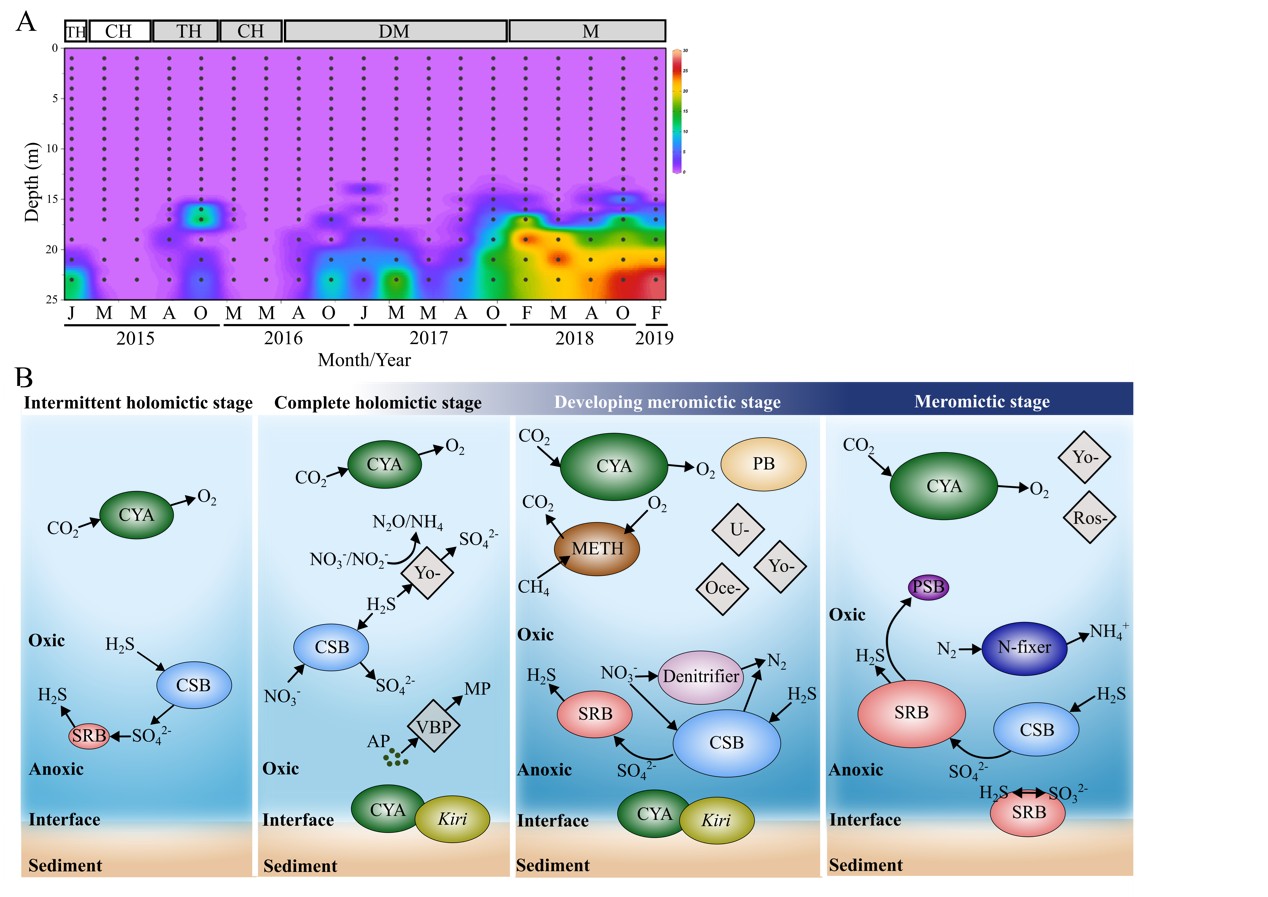
Figure 1. (A) shows changes in sulfide concentrations at different depths from 2015 to 2019, reflecting the transition from stratification breakdown to recovery in the meromictic lake. (B) provides a schematic overview of ecological functions across different hydrodynamic stages, showing the re-establishment of an oxygenated surface layer and an anoxic deep layer, together with the recovery of associated sulfur, nitrogen, and carbon cycling functions.